 Lens

Introduction
We’re excited to introduce IRIS : an aggregated fixed-rate origination layer built on top of DeFi’s deepest lending markets.
IRIS lets borrowers access fixed-rate loans without requiring fixed-rate liquidity to be pre-built in isolated pools.
Instead, borrowers submit an intent, bonded solvers compete to quote the best fixed rate, and the winning solver borrows and manages position across existing variable-rate lending venues.
By aggregating liquidity across venues and separating the fixed-rate guarantee from the underlying lending capital, IRIS is designed to deliver more competitive fixed-rate quotes and scale with the full depth of DeFi credit markets.
Fixed-Rate Lending in DeFi
Fixed-rate borrowing is a fundamental credit primitive. In traditional finance, much of consumer and institutional debt depends on predictable funding costs.
DeFi has not yet provided this capability effectively at scale.
Variable-rate lending protocols such as Aave, Morpho, Spark, and Fluid dominate onchain credit. Their utilization-based rate models are efficient for managing pool liquidity, but they produce inherently unpredictable borrowing costs. Demand for fixed-rate alternatives is clear while the bottleneck has been supply.
Existing Variable-Rate Liquidity as Substrate
DeFi’s variable-rate lending markets represent one of the ecosystem’s deepest pools of productive capital. They are liquid, battle-tested, and continuously growing.
The premise of IRIS is that fixed-rate lending does not require fixed-rate liquidity to exist natively at every venue. If variable-rate liquidity already exists at scale, then the missing piece is a mechanism that can transform variable-rate exposure into fixed-rate borrowing without bootstrapping a new lending market from zero.
Then the protocol's capacity ceiling becomes the total addressable liquidity across all integrated variable-rate venues, rather than its own TVL.
The underlying lending venue provides the capital. The solver provides the fixed-rate guarantee.
IRIS coordinates origination, competition, settlement, and enforcement.
Introducing IRIS

IRIS shifts fixed-rate lending from a static pool model to an origination model.
Instead of relying on AMMs or order books where pooled liquidity collectively prices rate risk, IRIS creates a marketplace where individual solvers compete to originate fixed-rate loans on top of existing lending venues.
The borrower signs an intent describing their desired loan terms: collateral, borrow amount, duration, maximum acceptable fixed rate, and allowed venues. Solvers evaluate the intent, price the rate risk using their own models, and submit competing signed quotes through an off-chain RFQ system.
The best quote is selected and settled onchain. The winning solver locks the required bond, routes the position through one of the allowed lending venues, and delivers the borrowed funds to the borrower. For the duration of the loan, the solver actively manages the position, monitoring rates and potentially refinancing or rebalancing across venues to keep funding costs below the quoted fixed rate.
At maturity, the borrower repays the fixed amount. If the realized variable-rate cost was lower than the quoted fixed rate, the solver captures the spread. If the realized cost was higher, the negative carry is covered by the solver’s bond.
From the borrower’s perspective, this remains a standard fixed-rate loan. Underneath, solvers are managing variable-rate exposure across DeFi’s lending markets.
The flow:
- Intent — The borrower signs a gasless message specifying collateral, borrow amount, duration, maximum acceptable fixed rate, and allowed venues.
- Competition — The intent is broadcasted to registered solvers through an off-chain RFQ system. Solvers evaluate the loan and submit competing fixed-rate quotes.
- Settlement — The winning bid is settled onchain. The solver locks bond capital, opens the loan through an existing lending venue, and delivers funds to the borrower.
- Management — The solver manages the position over the loan’s duration, monitoring rates and refinancing or rebalancing across venues where beneficial.
- Closure — The borrower repays the fixed amount at maturity. The solver’s profit or loss is settled against the bond.
Design Principles
Per-loan Judgement Pricing
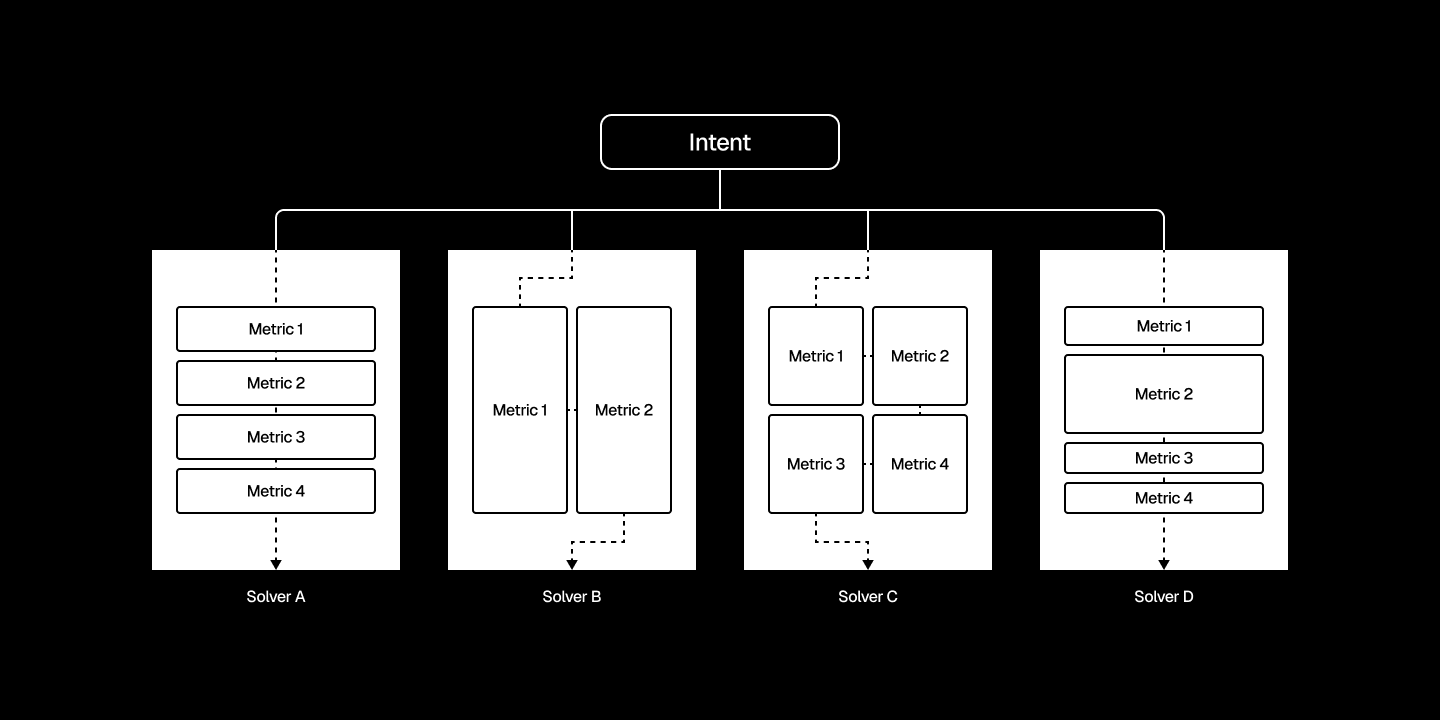
Fixed-rate loans differ from one another in ways that matter economically. Duration, size, current utilization, venue-specific parameters, and broader market conditions all affect the true risk of underwriting a fixed rate.
A 30-day loan during low utilization is meaningfully different from a 180-day loan during a liquidity crunch. A small loan on a stable venue is different from a large position that may require active refinancing across multiple markets.
IRIS replaces pool-based consensus pricing with individual solver judgment. Each solver evaluates each loan intent against its own models, including, but not limited to:
- Duration risk: How much rate volatility to expect over the specific time horizon
- Size impact: Larger positions require more complex venue management and carry higher rebalancing costs
- Venue conditions: Current utilization, proximity to rate kinks, historical volatility on the target venue
- Market timing: Rate trends, upcoming events, macro conditions
This allows solvers with better models, better execution, or better access to liquidity to offer tighter fixed-rate quotes where they have edge, while passing on loans where they do not.
The borrower benefits because solvers compete on the same intent. Rates are not set by an averaged curve across dissimilar demand; they are produced by competitive underwriting of each specific loan.
Shared Bond Capital
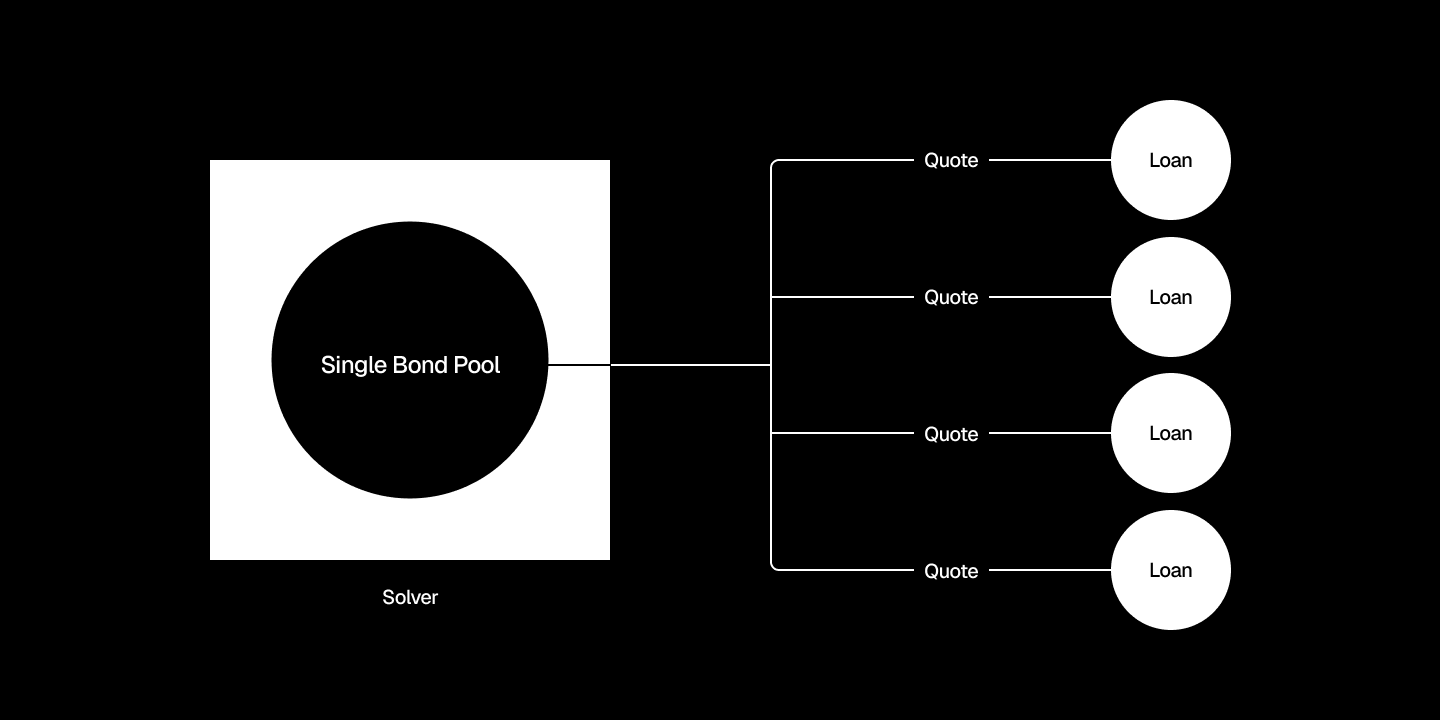
A solver keeps capital into a shared bond pool. When a borrower intent is settled, a portion of that bond is locked as the guarantee for that specific loan. The same bond pool can support loans across different venues, assets, and durations, depending on what the solver chooses to underwrite.
Capital is allocated when borrower demand appears, not pre-committed to isolated markets before demand exists.
This makes solver capital more flexible. A solver can use the same general-purpose commitment capacity to support a portfolio of loans across venues, allocating capital toward the best risk-adjusted opportunities as demand arrives.
Solver alignment through competition and bonding
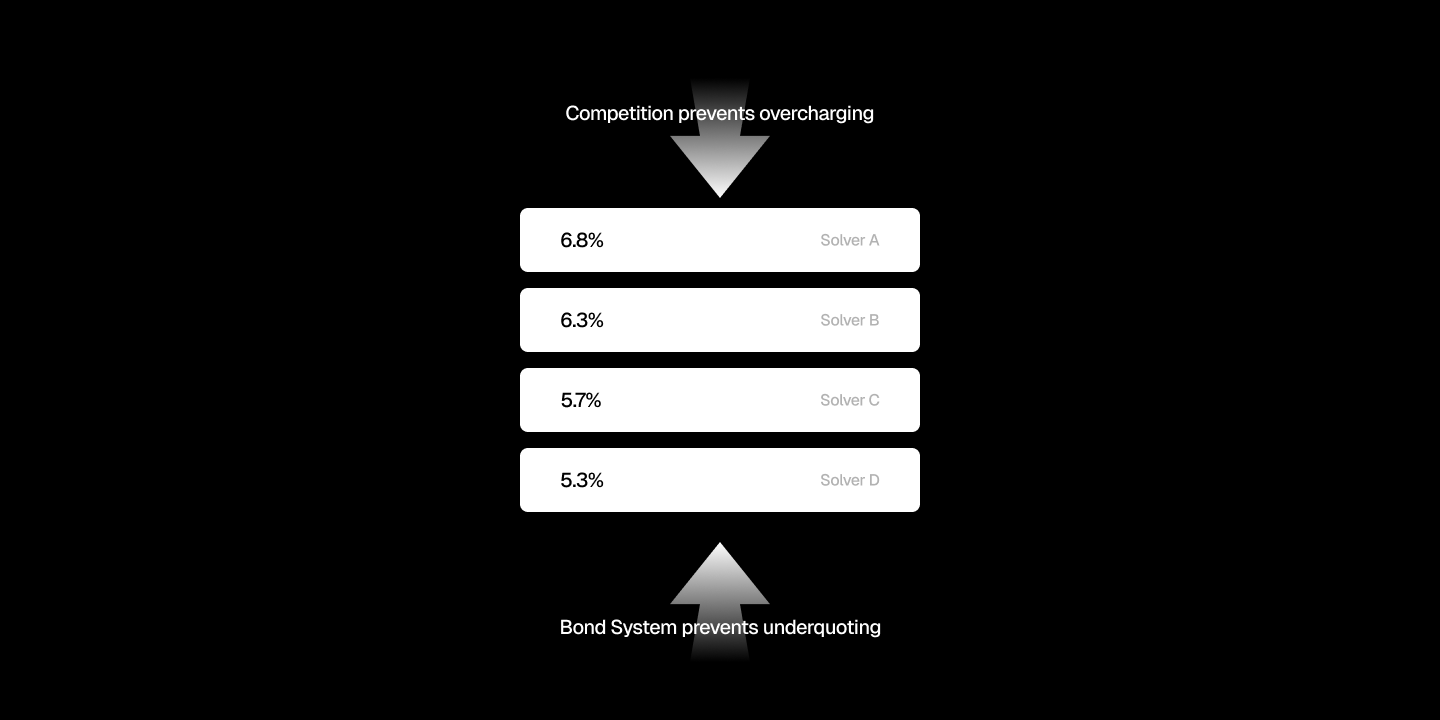
Solvers are not passive lenders, and they are not altruistic agents working on behalf of borrowers. They are profit-seeking rate underwriters whose incentives are aligned through competition and bonding.
Competition drives rates down. Multiple solvers evaluate the same borrower intent. To win the loan, a solver must offer a rate the borrower finds acceptable and must do so more competitively than other solvers. This pushes each solver toward its true indifference point: the rate at which expected profit justifies the capital cost of locking bond and the operational cost of managing the position.
Bonding enforces performance. The solver’s bond guarantees the fixed-rate quote. If variable funding costs exceed the quoted fixed rate, the deficit comes from the solver’s capital. A solver that systematically underprices rate risk loses money, making inaccurate pricing economically self-correcting over time.
The borrower does not rely on solver generosity. The borrower benefits from solver competition, and the fixed-rate promise is enforced by solver capital.
Active Liability Management & Dynamic Optimizaiton
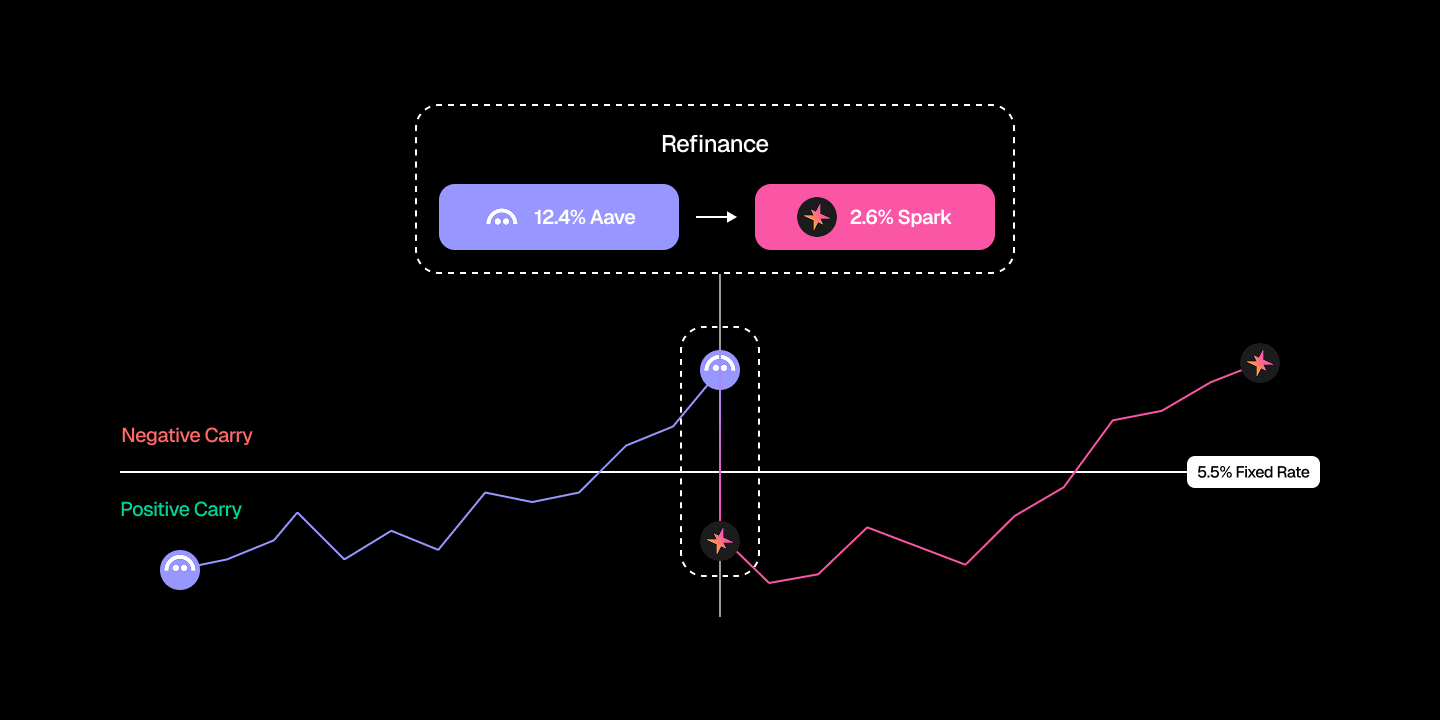
Traditional financial institutions do not fund long-term fixed-rate loans by perfectly matching every liability with an equivalent fixed-rate deposit. They actively manage liabilities, continuously adjusting funding sources to reduce cost and control risk.
IRIS brings this logic to DeFi.
When a solver quotes a fixed rate, they are not necessarily locking a static back-to-back position for the entire loan duration. Their edge comes from managing the cost of capital over time. They can monitor venue conditions, refinance across markets, rebalance positions, and capture rate differentials where opportunities exist.
A solver is not locked into a single venue’s rate environment. By accessing a broader opportunity set across integrated lending markets, solvers can price loans based on their ability to manage the liability over the full lifecycle, not just the rate available at a single venue at one point in time.
This is why aggregation matters. IRIS does not simply route borrowers to one lending market. It creates a competitive origination layer where solvers can use multi-venue liquidity and active management to deliver more competitive fixed-rate quotes than any single venue can reliably provide on its own.
What’s Next?
IRIS is built on a simple premise: fixed-rate borrowing does not require fixed-rate liquidity to exist natively at every venue, proposing a different interface between borrowers and lending markets in DeFi.
Borrowers specify the outcome they want. Solvers compete to deliver it. Existing lending venues continue to provide the underlying liquidity. The protocol coordinates these roles without requiring capital to be siloed inside a new fixed-rate pool.
If this model proves out, the implication is broader than a single fixed rate lending primitive. The architecture creates room for a broader ecosystem to emerge around origination, solver infrastructure, venue adapters, and specialized liability strategies. Some participants may focus on underwriting particular assets or durations. Others may build execution systems, refinancing logic, or new venue integrations that expand the solver opportunity set. Fixed-rate borrowing is the first expression of that design space, not the last.
As IRIS moves toward Exclusive Mainnet, we are looking to work with a small set of early counterparties who are well-positioned to stress the system in real conditions: borrowers with repeat structured borrowing demand, and solvers capable of managing positions across venues with discipline. If that describes you, we’d welcome a conversation.
Thanks for reading.