 Lens


While DeFi is often viewed as a vacuum constantly in need of more liquidity and TVL, the reality is that there is no structural shortage of capital starving for yield. However, the industry has mistaken a surplus of supply for a healthy ecosystem, failing to realize that the true constraint is finding durable, economically sound demand for that capital.
Building on my previous work regarding M1 Expansion(1), this article explores why we have pivoted our focus from supply to demand, and why the traditional supply-vs-demand debates of legacy finance simply do not apply to the unique mechanics of DeFi.

In TradFi, credit demand is anchored in real activity:
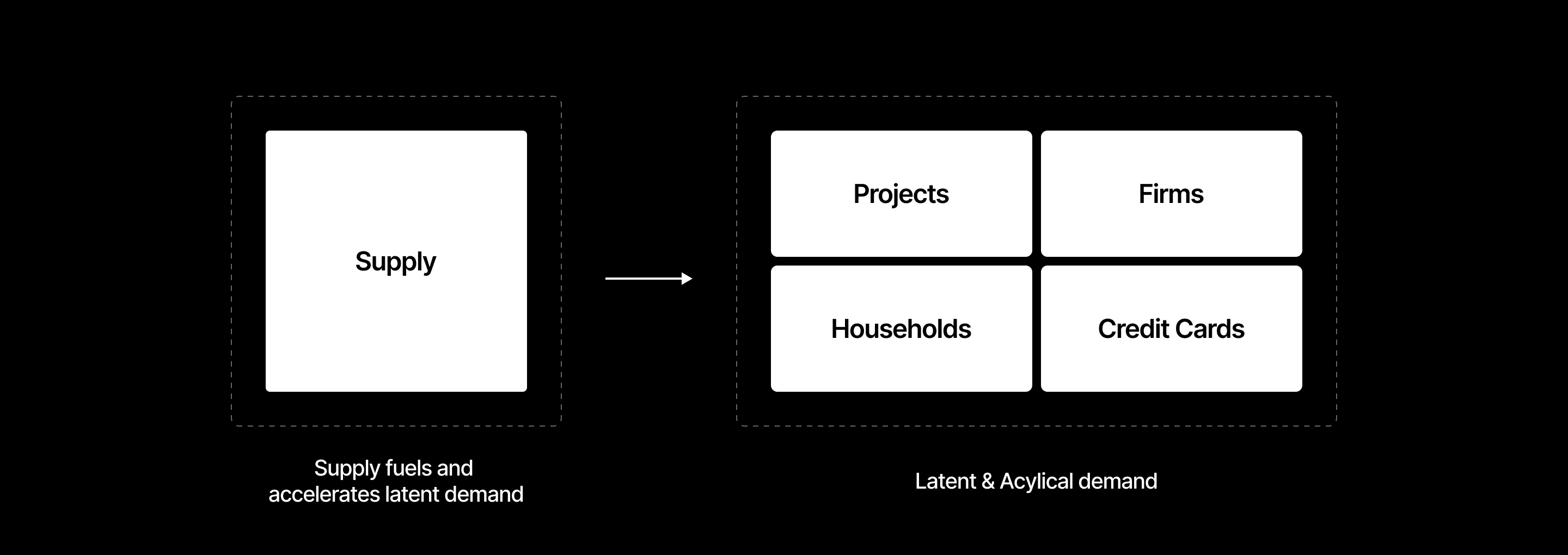
firms finance capex and working capital, households finance housing and education, creating a baseline need for funding that persists across cycles. This creates a latent and acyclical baseline for funding that persists across market cycles. In this context, lowering the cost of capital acts as a demand creator. Because there is a vast backlog of real-world projects waiting for viable unit economics, reducing interest rates unlocks that suppressed demand, turning a "no" into a "yes" for a mortgage or a factory expansion. This creates a virtuous loop where borrowing fuels productivity, multiplying economic output and providing a steady counterbalance to speculative excesses.
Rates in DeFi are not a clean proxy for “strong demand” but a downstream reflection of a specific mix of speculative activity, funding conditions, and market structure at a point in time. In contrast to traditional systems, where rates serve as signals of underlying productivity, time preferences for savings, and future growth potential, DeFi yields frequently magnify immediate market sentiment, distorting perceptions of value without the grounding of real economic contributions.
Because on-chain demand is primarily contingent and endogenous, it does not respond to lower rates by finding new productive uses. If the "useful work" for a dollar isn't there—if there is no basis trade to capture or incentive to farm—dropping the cost of capital from 5% to 2% doesn't create a new borrower; it simply subsidizes the margins of existing speculators. Lowering the cost of capital makes the closed loop of DeFi spin faster, but it cannot expand the loop's diameter.
Even in traditional finance, demand constraints matter more than textbook models imply. The intuition that "more savings equals more lending capacity" has been deeply embedded in economic thinking and it has a name: loanable-funds theory. It treats savings as the binding constraint, with deposits first and lending second, but a large body of modern banking research(2) shows that banks extend credit by creating new deposits, and then fund those positions afterward. What limits them in practice is not the stock of savings, but whether there is creditworthy, economically meaningful demand for borrowing at prevailing terms.
When that demand is weak—when firms will not borrow even at low rates—surplus savings can sit in low-yield assets or safe instruments and function more as a drag on aggregate demand than as productive capital. That gap between “capital exists” and “capital is actually used” becomes even more pronounced in DeFi.
Onchain, most “demand” is contingent rather than latent:
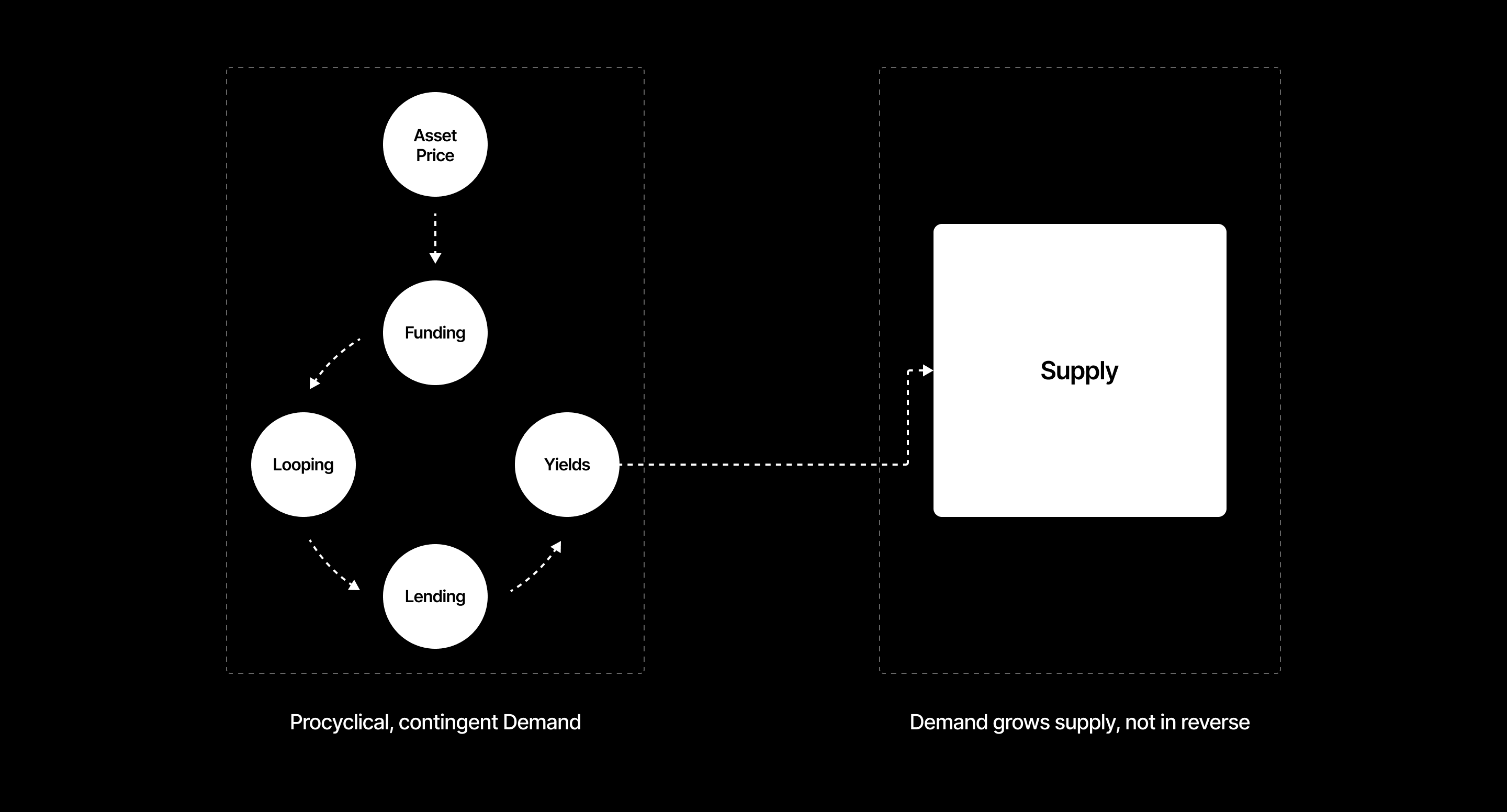
it appears only when external conditions (bull markets, funding dislocations, or rewards) line up, and it evaporates the moment those conditions fade. Borrowing and leverage activities are largely driven by exogenous factors like asset price trends and perp funding, rather than by long-lived productive needs.
This is the core mismatch: while TradFi has a structural floor of demand that expands as capital gets cheaper, DeFi has a speculative ceiling. Once the immediate appetite for leverage is saturated, more supply merely leads to yield decay and alpha compression, rather than sustainable economic growth.
This shows up clearly in yield-bearing stablecoins and vaults:
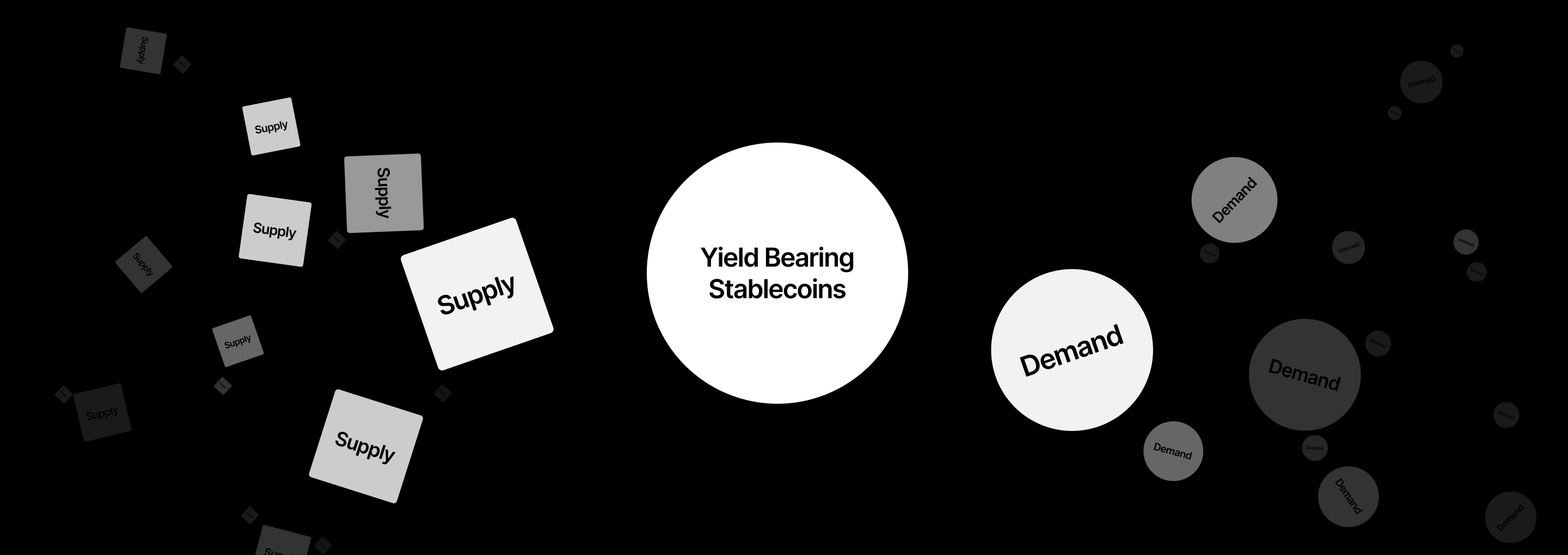
Viewed through this lens, yield-bearing stablecoins, structured vaults and even lending markets are not demand engines but capital-formation vehicles. Their long-run scalability is determined by how much genuine external demand (e.g., perp funding, basis trades, RWA credit, hedging flows) they intermediate.
Ethena-style tokenized funds are a good illustration:
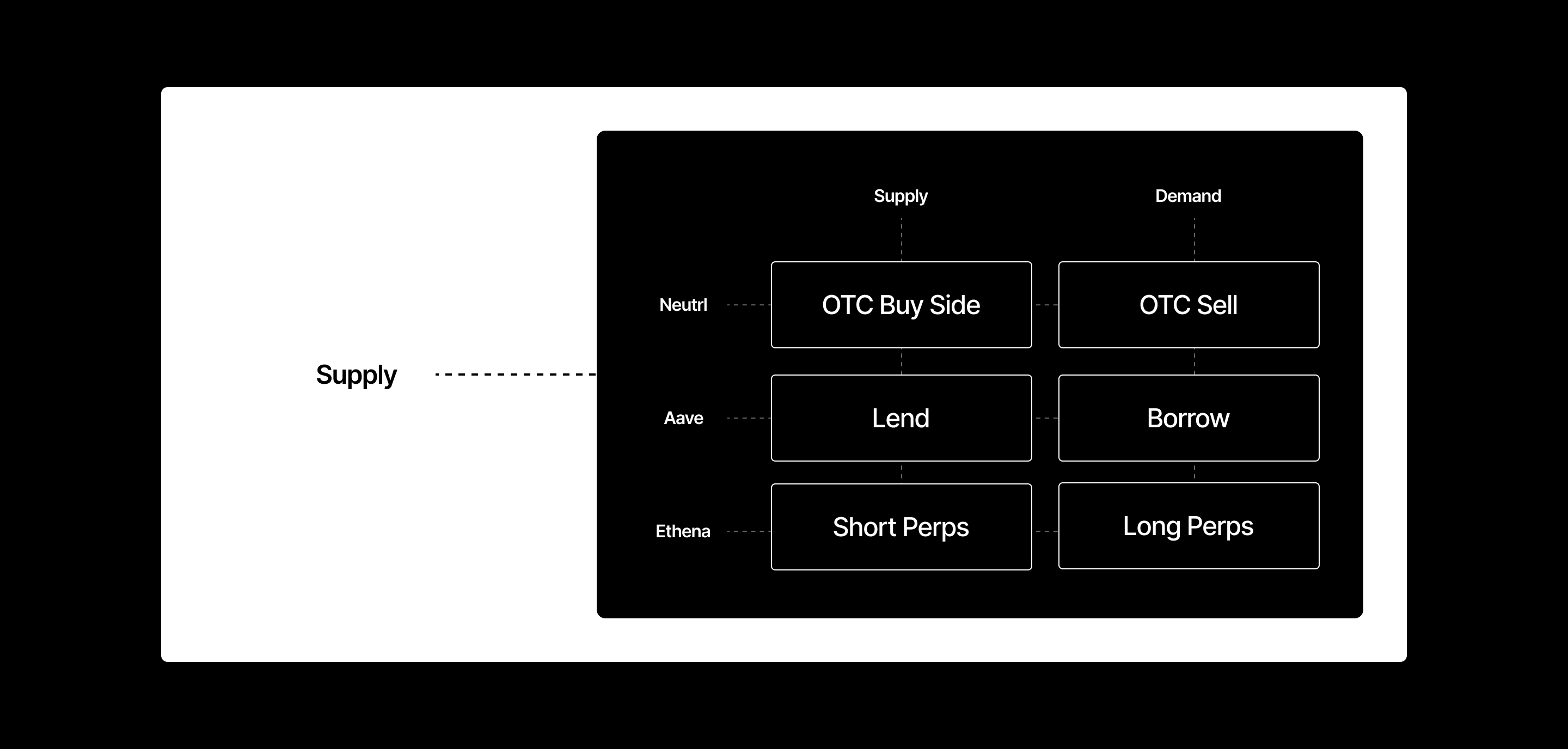
as a capital formation vehicle, they don’t intuitively appear to have their own demand side of the market, but in reality they sit at the junction as a “supplier” to broader market “demand” for leverage and hedging.
When markets want to be long and pay positive funding, yields and supply can grow rapidly; when that reverses, the underlying driver turns. Such funds channel liquidity flows effectively during high-velocity periods, but their sustainability depends on maintaining alignment with consistent market expectations, rather than relying on transient spikes that falter when circulation slows.
Ethena broke out because it plugged into a source of demand that was bigger than DeFi-native leverage alone, tapping exchange-scale perp funding and hedging flows at the exact moment those flows were near their cyclical peak. Its growth was less about “inventing” demand inside DeFi and more about routing a large, existing demand curve for dollar yield and basis trades through a new, composable wrapper, demonstrating how bridging external structural needs can extend beyond internal limitations.
Yet, yield compression triggered a 50% TVL drop in USDe by late 2025, despite onchain usage rises, as traders avoided risks. USDe supply plummeted 40% amid market caution.
Demand constraint compounds at scale
Aave dominated DeFi lending with 59% market share and $885 million in 2025 fees. Even in an environment where most capital-formation vehicles are demand-constrained, Aave benefits from a very sticky depositor base with relatively modest return expectations, which keeps its cost of capital low and allows demand to remain stable throughout and across cycles.
Still, because Aave is so large, lack of demand source with matching scale creates a problem when listing new yield-bearing collateral.
When demand doesn't scale proportionally to Aave's liquidity depth, adding risk doesn't add corresponding returns for lenders. It might create marginal improvement, but the economics break down quickly.
Listing a yield-bearing asset on Aave (assuming sufficient looping demand exists) essentially pours hundreds of millions of dollars into the underlying strategy. If that strategy's yield source isn't scalable to absorb this capital, the alpha decays. As the collateral yield compresses, borrow rates converge back down. People won't borrow at 5% when collateral yields 4%, but if that yield decays from 4% to 3%, borrowers won't sustain even 4% borrow rates.
Across DeFi, this leads to a simple conclusion:
The era of TVL at all costs only is over.
As macro trends accelerate the growth of onchain supply, such as the proliferation of stablecoins and a declining interest rate environment, the "yield-starved" capital problem will only intensify.
The industry's true bottleneck has shifted to high-quality, durable demand.
Moving forward, the protocols that define the space will be those that can successfully facilitate demand that is
- Scalable (large notional that can grow without breaking economics).
- Sticky (flows that are structural rather than purely opportunistic).
- Less cyclical or acyclical (linked to real activity or structural hedging needs, not just bull-market leverage).
Thanks for reading.