 Lens



Before we can have competitive fixed-rate quotes, the underlying variable rate markets need to be more efficient. Fortunately, there's a new approach which offers fixed-rate loans while simultaneously arbitraging inefficiencies in the underlying variable-rate markets.
In my latest article, I argued that fixed-rate lending in DeFi has a structural problem: borrowers want fixed rates, but the supply side wants instant liquidity.
Originating fixed-rate loans transfers rate risk from the borrower to the lender, which is fine so long as the lender wants fixed rates over the duration of the loan. In a vault promising instant liquidity, but holding fixed-rate loans, rate changes lead to runs or dilution. The rate risk has to live somewhere. If not with the lender (fixed-rate markets) and not with the borrower (variable-rate markets), then the rate risk must be isolated to a third-party. This means that the lender extends variable-rate credit, the borrower receives a fixed cost, and a separate party warehouses the rate exposure between them. The natural solution is an interest rate swap (IRS), however, there’s a more immediate problem that must be addressed: borrower liability management.
Lenders Have Curators. Borrowers Don't.
Vaults have (mostly) solved lender-side allocation as curators move capital across markets and compress obvious yield spreads. Borrowers have no equivalent. They are expected to manage their positions across venues, collateral types, debt assets, and refinancing opportunities. This asymmetry is clear in the data.
Borrow Rates are Volatile
Across Aave and Morpho, the weekly average borrow rate for a standard BTC-backed (cbBTC, wBTC) stablecoin (USDC, USDT) loan has ranged from roughly 2% to roughly 16% since October 2024. That range covers what borrowers actually paid on the most liquid, most standardized credit configuration in DeFi. This is the problem fixed rates are designed to address.
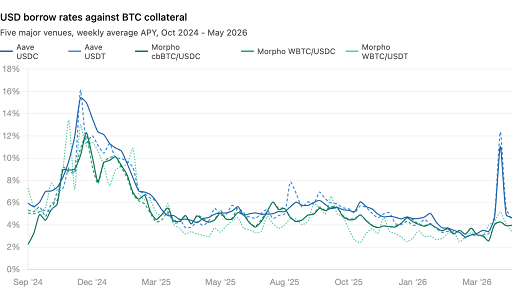
Some borrowers are fine with that volatility. Others can't be. A borrower running a trade with BTC collateral and stable debt deploying to a strategy with uncorrelated yield can't tolerate borrow-rate volatility eating into thin spreads.
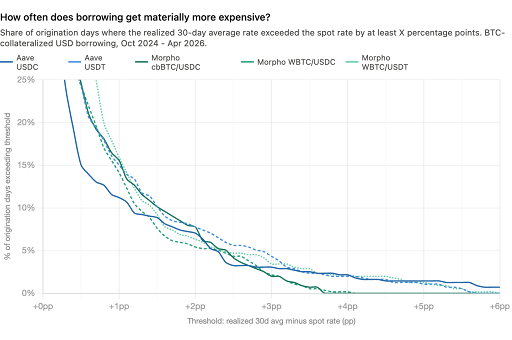
On at least 5% of days in each of the five markets, the realized average rate over the next 30 days was at least 2pp more than the rate at origination. That "rate surprise" is what fixed-rate borrowers are looking to avoid.
Cross-Loan Asset Spreads are Wide
Rate volatility isn't the whole story. Borrowers leave money on the table in ways that lenders don't. In the sample, there are three BTC-USD Morpho markets all with an 86% LLTV:
- cbBTC/USDC
- wBTC/USDC
- wBTC/USDT
The first two share the same loan asset (USDC) but differ in collateral. The second two share the same collateral (wBTC) but differ in loan asset.
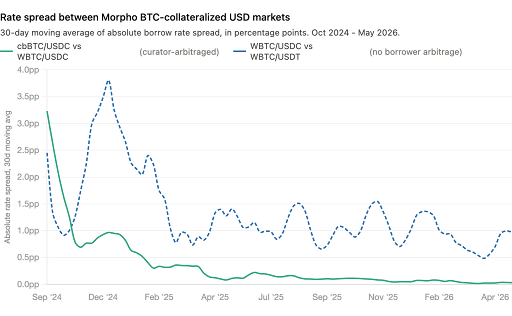
For the pairs sharing the same loan asset, curators can allocate between them, and capital flows toward the market offering the higher rate. If the rates diverge, allocators rebalance, and the spread closes. The data shows this clearly: across the full sample, the median absolute spread between the cbBTC/USDC and wBTC/USDC borrow rates is 9bp, and the spread has tightened over time as the curator ecosystem matured.
The borrow side tells a different story. From a borrower's perspective, markets with the same collateral and a different debt asset (wBTC/USDC and wBTC/USDT) should be similarly substitutable. If the rates diverge, the borrower should refinance toward the cheaper pool. The data shows this doesn't happen to nearly the same degree as on the curator side. And this is within the same protocol.
Cross-Protocol Spreads are Wide
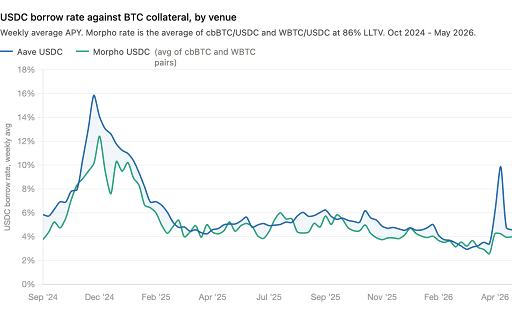
Across protocols, there is also a lack of arbitrage attributable to both borrowers and lenders. Borrowers need the equivalent of a curator. That is, someone incentivized to refinance loans across loan assets and venues. Hedging fixed rates against a single market is a step in the right direction, but the cost of those fixed rates will necessarily be much higher than what's possible if borrower-side liability management closes the venue and asset spreads first.
Why Swaps Aren't the Solution (Yet)
The instinctive way to isolate rate risk is though an IRS. A borrower paying a floating borrow rate would want the swap equivalent of receiving floating and paying fixed against that same rate index. That fixes exposure to one rate index. It does not tell the borrower which venue to borrow from, when to refinance, whether to switch loan assets, or how to capture cross-venue dislocations.
For DeFi to become more efficient, IRS markets will be required and likely a huge business. For now, the more immediate problem is the one the data above describes: borrower-side liability management is missing entirely. IRIS (@iris_credit) is a new protocol that attacks that bottleneck directly.
In IRIS, a borrower signs an intent for a fixed-rate loan and solvers compete to offer a fixed-rate quote. If accepted, the solver opens the actual debt as a variable-rate position on whichever underlying venue offers the cheapest credit at origination, and can migrate the position over the life of the loan if a better rate appears elsewhere. The solver's job is spatial arbitrage across venues, and any spread captured during the loan accrues to them as profit.
From the borrower's perspective, the result is a fixed-rate loan, not a loan-plus-hedge. From the underlying lending venue's perspective, it's a variable-rate position like any other. In this architecture, no fixed-rate asset sits on a vault's balance sheet. The fixed rate exists as a contractual obligation between the solver and the borrower, backed by the solver's bonded capital.
The solver fulfills the curator role for borrowers. They earn the spread between the fixed rate they quote and the variable rate they pay, so they are incentivized to route and refinance to the venues with cheapest and most stable variable rates. And, because solvers can underwrite this forward optionality when they bid, a competitive auction environment pushes them to pass part of that edge through in the form of tighter fixed quotes for borrowers.
IRS markets and IRIS-style solvers complement each other rather than competing. Solvers can hedge their own rate exposure with an IRS themselves rather than forcing borrowers to actively manage their loans and hedges.
Variable-Rate Markets as the Foundation
If borrowers route fixed-rate demand through IRIS, the marginal borrower is a solver who is highly sensitive to both rate level and rate stability.
Rate level impacts the solver's profitably directly because they earn the spread between the fixed rate they quote and the variable rate they actually pay over the life of the loan.
Rate stability matters because solvers are underwriting forward exposure they cannot perfectly predict. Migrating a position across venues isn't free due to gas cost, execution risk, and the possibility that the better rate has moved by the time the migration completes. A variable curve that's well-priced today but volatile over thirty days forces solvers to widen quotes to absorb the variance. A variable curve that's stable lets them quote tighter against the same expected average.
There are several ways the existing variable-rate markets can be made more efficient in anticipation of fixed-rate growth.
As I discuss in Concentrated Liquidity for Lending, multi-threshold markets price rates more accurately by enabling multiple risk parameters to coexist within a shared-liquidity market.
Also, productive debt minimizes the drag from idle capital. By denominating stablecoin credit markets in a yield-bearing vault allocated to tokenized MMFs, the borrower pays the base rate + credit spread. This reduces the borrow rate by ~35bps compared to idle debt markets and reduces rate volatility.
Counterintuitively, if you're bullish on fixed-rate borrowing, you should be focused on improving efficiency in variable-rate markets.
Thanks for reading.